Friday, 29 June 2012

Highlights of RHS Wisley, this June


On a rare sunny day, I took the chance of a quick visit to the gardens at Wisley. A real treat to add on to a plant shopping trip. Here are a few stars.


Monday, 21 May 2012

Wimbledon tree of the month. May

Cercis siliquastrum  (Common name Judas tree)
Standing proud, in a small area of planting, on the opposite side of the road to the war memorial in Wimbledon Village. This delicate tree heralds the start of Summer when it's pink flowers emerge.
The Judas tree has attractive and interesting flowers, foliage and form, it is an increasingly popular choice for gardens. Originating from South East Europe and West Asia.
The generic name, Cercis, comes from the Greek ‘Kerkis’, a weaver’s shuttle, which Theophrastus likened the tree's flattened woody fruits to. Its specific name refers to the prominent seedpods - ‘siliqua’ in latin.
There are many suggestions to the origins of its common name. But the two most common suggestions are, Judas is a corruption of Judean, as the tree was once common in the Judean hills. Or it was the tree from which Judas Iscariot hanged himself.
Introduced to the British Isles before 1600, it has become much commoner in our gardens in the last 20 years or so due to a combination of wider commercial availability, milder winters, and people seeking out more unusual plants for their gardens.
This tree likes full sun, partial shade and a well drained soil. The leaves appear late, after the spectacular clusters of pea-shaped blooms have emerged from the branches and even the main trunk.  From late summer, large bunches of rich, purple pods deck the branches, and last well into winter.


Tuesday, 1 May 2012

Wimbledon tree of the month. April

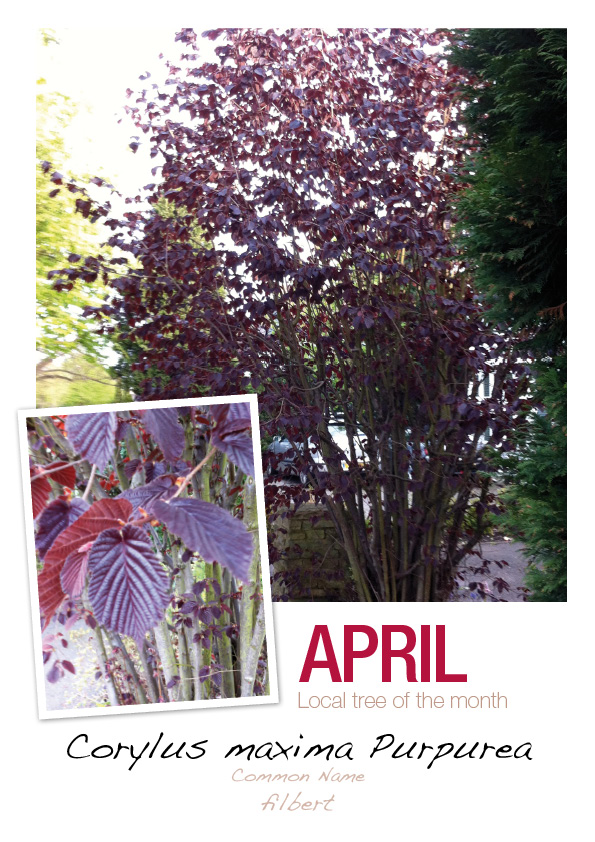
Corylus maxima Purpurea  (Common name Filbert)

I've been waiting for a couple of weeks to take some shots of this multi stemmed hazel on a sunny day. But it never happened - so my tree of the month for April, scrapes into May!
Standing in the front garden of a house on Coombe Lane, just opposite the junction of Cambridge Road. This purple hazel is especially eye catching at this time of year, when the foliage has newly emerged. The colour is just slightly more rich and intense. The typical multi stemmed tree creates an elegant goblet shape which works perfectly in this position, at the side of the driveway.
The Purple Hazel, Corylus maxima Purpurea, is a variety of Filbert hazel. This ornamental tree is also produces large, nuts with a pretty, wine-purple tinge inside them. It is very hardy and suitable for any soil, although it is not quite as good in the shade. Purple Hazel is a good hedging plant, and can reach about 10 metres if it grows freely as a tree. The great thing about these trees, is they are happy being pruned to keep them in a size and shape which works with your space. The Purple Hazel has won an RHS Award of Garden Merit for being easy to grow and lovely to look at.


Tuesday, 17 April 2012

Sculpture in the Garden

Last October I made my first visit to the Hannah Peschar Sculpture Garden, which opens once again in May. I look forward to my next visit, to see what has changed.


Here is a taster of what to expect.


www.hannahpescharsculpture.com


Friday, 13 April 2012

Garden Burner

Light up the longer evenings with this atmospheric garden burner.

I saw it at the Landscape Show at Olympia, on the Luxius Outdoor Kitchen stand.


Beautiful Sculpture

I'm always asked for ways to make enclosed spaces look more attractive.


If a wall has enough light, my first thought is to cover it with plants. Either climbers or 'Green Walls'. But a low maintenance and striking choice, is to place a sculpture there.
This rusted metal fern sculpture is beautiful, and is at Wisley at the moment.


April at RHS Wisley


This is one of the best times of the year to visit Wisley. The unusually good weather has made everything even more impressive.


The Magnolias and Camelias are particularly good, as we didn't have the usual high winds to destroy the blooms.


Even the new leaf growth looked stunning.


Wednesday, 14 March 2012

Wimbledon tree of the month. March

Acacia dealbata (also known as the Silver Wattle or Mimosa)
Once again, I've chosen an evergreen. Found on Murray Road towards Ridgway, this native to New South Wales, Victoria and Tasmania is a fine example with a beautiful shape. The shoots are noticeably angular in section and bear true, bipinnate, blue green leaves. It is not hard to see why the foliage is often included in cut flower arrangements with it's attractively fern-like leaves. The highly fragrant, and velvety looking flowers, are borne in spring, with spherical clusters of conspicuous yellow stamens. Although they do seem to be earlier this year.
   Acacia dealbata is tolerant of several degrees of frost and it has been known to survive at -10ºC for short periods. So this tree benefits from it's Southerly aspect. However, young plants are susceptible to cold Winter winds.
   The cut Mimosa flowers are harvested and given to women on International Women's Day in Italy, Albania, Russia and Georgia. While in India, they use the essence of the flowers in perfumes.


Tuesday, 28 February 2012

Wimbledon tree of the month. February

Cedrus libani  (Also known as Cedar of Lebanon)
On any visit to the grounds of Cannizaro House, you can’t help but be impressed by this statuesque tree. As you follow the path from the common to the main lawn area, you are 
faced with this dramatic specimen, which stands sentry, at the border of tended garden and woodland walks. 
   As with most of the trees I choose in the Winter months, this is evergreen, provides a strong foil to the woodlands behind. Few trees, deciduous or evergreen, can compare with the beauty and elegance of a mature Cedar, and it was extensively planted as part of the enduring landscape of some of our grandest stately homes and estates.
   Interestingly this tree does not originate from Lebanon but in fact was found growing on the slopes of Mount Lebanon in Syria. It requires full sun in well-drained soil, but will tolerate exposure.
   The Cedar of Lebanon has been important to various ancient civilizations. The trees were used by the Phoenicians for building ships, houses, palaces, and temples. The ancient Egyptians used its resin in mummification, and its sawdust has been found in the tombs of Egyptian Pharaohs. The Sumerian Epic of Gilgamesh designates the cedar groves of Lebanon as the dwelling of the gods to which Gilgamesh, the hero, ventured. So it somehow seems fitting to find such a tree in the grounds of one of Wimbledon’s most 
prestigious houses.


Tuesday, 31 January 2012

Wimbledon tree of the month. January

Taxus baccata  (also known as Yew)
Standing proud on the edge of Wimbledon Village and facing the common. This Yew, which is one of a pair of native British evergreens, has been cleverly clipped into a long busby shape. I always feel, the strong form works well adjacent to the shape of the War Memorial. 
Young Yew plants are bushy and, if left unclipped, they eventually grow into large trees almost as wide as they are tall. However they are rarely allowed to grow naturally, being a firm favourite for classic style hedges and topiary. The potential age of yews is impossible to determine accurately and is subject to much dispute. Even lower estimates at 2,000 years makes Taxus baccata the longest-living plant in Europe.  They are quite amenable to growing conditions and will grow in any well-drained soil. Most parts of the tree are toxic, except the bright red aril surrounding the seed, enabling ingestion and dispersal by birds.


Friday, 24 June 2011

Wimbledon tree of the month. June

Fagus sylvatica 'Dawyck Gold' (also known as Fastigiate Golden Beech)
Sheltering in a small clearing of woodland, within the grounds of Cannizaro House is this young tree that bursts with potential.
The golden leaf form of Fastigiate Beech is an architectural beauty, and worthy winner of the Award of Garden merit in 2002. This large native tree is both hardy and tolerant, but it is it's striking colour and form, that sets it apart from your average woodland. The cultivar 'Dawyck Gold', is a small, upright, deciduous tree whose young leaves are bright, acid yellow, turning gradually to green in summer, before reverting to yellow in autumn. This tree's flame shaped habit works well against it's dark background of mature trees, to punctuate this wooded backdrop. With a mature height of 20 metres, this tree isn't for everyone. But in this position it perfectly transforms the relaxed woodland into something more befitting of this grand house. I feel the Wilsons, who owned the house until the late 1940s, and carried out a series of improvements in the gardens with the planting of new trees, would approve of this recent addition.


Thursday, 12 May 2011

Wimbledon tree of the month

In appreciation of my local area, I've decided to nominate a 'Tree of the month'. This will be a local tree I feel has notable characteristics to make this example special. It might be an unusual specimen, not often seen in the area, or it might just be a fine example of it's type. Sometimes it's position in the landscape or environment elevates it from something average to something striking. 

Paulownia tomentosa (also known as the Empress Tree, Princess Tree or Foxglove Tree 
I have admired this specimen for many years. Found at the junction of Pepys Road and Langham Road, it really grabs attention in May, with it's spectacular flowers, which are produced before the leaves. The panicles with a purple corolla do resemble a foxglove flower, and not often seen in such a public position. Centred on a small triangle of green turf, it seems to enjoy it's position where it benefits from full sun. I have seen them in private gardens where they are pollarded to keep them small and maximise their leaf size and create drama. But this process means you never see the blooms as they only form on mature wood!
In China, an old custom is to plant this tree when a baby girl is born. The fast-growing tree matures when she does. When she is eligible for marriage the tree is cut down and carved into wooden articles for her dowry.


Thursday, 31 March 2011

Spring has sprung

There is no doubt that Spring has arrived. The signs are everywhere.

Helleborus Orientalis
Back in popularity, the Lenten rose is a must-have plant. I love it's unassuming nature and staggering variety of colours - ranging from immaculate white to virtually black, as well as every shade in between through pinks, purples, clarets, yellows and greens. Hellebores hang their heads demurely, and one can't resist gently turning up their flower heads to appreciate the individual subtleties. I like to plant them under deciduous trees, combining the pinks and clarets colours with Pulmonaria.


Pulmonaria
Grown for their early flowers in late Winter and early Spring, they are among the first perennial blooms. But their all too often overlooked hairy leaves with attractive silver spots, come into their own once the flowers have finished. Grow in woodland among shrubs in a humus-rich, moist soil.


Magnolia x loebneri
I can't help feeling every garden should have a magnolia at this time of year. There are so many to choose from, no matter what your taste. But I prefer the delicacy of Magnolia Loebneri and stellata.  These small, slender branched deciduous trees are perfect fits for modern and traditional schemes. The star shaped flowers, with slender white petals suffused with lilac edges are produced before the leaves emerge. They need an acid to neutral soil, but the smaller varieties do well in pots.


Anemone blanda
These cheerful plants bring a a smile to my face. The daisy shaped flowers appear in early spring over deeply dissected or toothed green leaves. Plant them amongst other ground cover plants in humus-rich soil in partial shade. 


Monday, 14 February 2011

Early promise

The signs are here. Those plants that cheer up, even the most dull and miserable days, have arrived. Their optimism never ceases to amaze me. But they are always such a welcome sight, as you can start to believe that Spring, with all it's colour and vibrancy is just within reach.

Here are just a few stars I have seen in the last few days.


Hamamelis x intermedia
The Witch Hazel is a deciduous shrub, perfect for a woodland area or a shady border. They have good Autumn colour, but it is their fragrant, starburst -shaped flowers that dazzle at this time of year. There are lots of varieties available, but they do vary considerably. So I would always recommend you do some research and buy them in flower. Some have a simplicity about them, while others are much more bright and showy.


Galanthus Sir Herbert Maxwell
I know they're predictable, but I do think no garden should be without Snowdrops. They are the first bulbs to show, their pear-shaped, delicate white flowers. They are sometimes scented. I prefer the more simple, single shapes in pure white and green.  But their are many options, and some much more complex double, frilly types. Best to buy them 'in the green' rather than as dormant bulbs. All parts may cause mild stomach upset if ingested; contact with bulbs may irritate skin.


Helleborus Argutifolius
The Corsican hellebore has leathery, elliptic dark green leaves, with spiny-toothed edges. I like the plant's strong architectural shape, making it suitable for both modern and naturalistic planting schemes. Pendent, shallow, bowl-shaped flowers appear in Winter to early Spring. I find Hellebores most effective when grown in groups in a border, or naturalised in a woodland garden


Sarcococca X confusa
The shiny leaves of this bushy shrub keep it looking good all year round. But it is during Winter and early Spring when it's fragrant white flowers turn it into something special. The delicate flowers are followed by attractive, glossy black fruits. Looks good as an informal hedge, or as ground cover in dry shade.


Tuesday, 4 January 2011

A blank canvas

The arrival of snow this Winter, reminded me how this is a perfect time to review your garden's design.

As a designer and gardener, the winter is one of the best times to observe and assess your outside space. Many shrubs and trees have lost their leaves and herbaceous plants have died back, leaving the naked skeleton in view. Evergreen shrubs and trees have jostled from their supporting roles all year, taking their opportunity for star position. But the addition of a layer of snow reveals everything in a new perspective. Suddenly, texture and colour has vanished, and all you see is the pure structure of your garden. This is your perfect chance to evaluate what you see, and decide what you would like to see.

Take some pictures if you can or draw a sketch. Note the shapes you see and decide what is working well and where you would like to see changes. For instance, is your boundary totally revealed, or are portions concealed to create interest and the suggestion of hidden treasures? I always like to see something sculptural emerge from the snow. A clipped tree to draw your eye or a hedge to hide a section of the garden. Consider the proportions of your garden and whether divisions or changes in levels would improve your view?
This is your chance to plan new projects, list garden 'must-haves' and maybe devise some new resolutions. Make a wish list that is sensible and achievable.

Don't forget about the birds and insects at this time of year. Providing water, food and shelter, will give refuge to these beneficial creature, attracting them to your garden throughout the year. 

For most gardeners this is one of the most dispiriting times of the year. But by making the most of your time inside - you will maximise your appreciation of your outer space for the rest of the year. Remember, below the ground roots are flexing and bulbs swelling, and before we know it, we will be welcoming the first signs of Spring. 

Thursday, 7 October 2010

Designs on your garden

There are two ways of achieving the garden of your dreams.You can create it yourself, or use a designer. Whichever you choose, here are some things to consider before making a start.

1. Think about how you want to use the space 
You might for instance, want a create a space for drinks in the evening if that's when you use it most. Do you need a play area for the children?  Is your dream to grow fruit and vegetables or have cut flowers in the house? Everyone will have a different list, and it's important to give carful consideration to this before you start your project.

2. Look at your environment 
Which way does your garden face?  What direction is the prevailing wind? Where is the shade?  Do you have existing feature, trees, paving that you are keen to keep?  Are there views beyond the garden you want to keep, or would you rather contain your view within the space?  Are there elements you are keen to remove or disguise? Is there a slop or existing levels that you would like to work differently?
If you commission a designer they will test your soil and analyse your site and plant appropriately. You can buy soil testing kits from your garden centre, or you can observe the plants in the surrounding area, to give you a rough start. 

3. Consider your architectural style and interior
Do you want your garden to reflect the exterior of your home, or would something that reflects the interior style be more appropriate?  Interior materials and colours, used outside will create a harmonious effect. Have you seen materials you are keen to use?

4. Looking after the garden
Except that maintenance is an essential part of any garden, so consider how much time you can spend or whether you can afford someone to do it for you? 

5. Features to include
Many people have furniture, statues and sculptures the want to include in their new space. Careful positioning can enhance the garden while lighting will increase their impact. 

5. When should you plan a new garden
Many people think about making changes to their garden when they're a new home owner, or they are extending their house and want it to integrate the two spaces. Others think that Spring is a good time to start planning their outer space so it is all complete for the Summer. 
However,  the design process can take a few weeks, so plan ahead so that the designs are ready for when you'd like the build to start. Good landscaper contractors can often be booked up in advance, and so allow for time between the design completion and build starting. Spring can also be a very busy time for landscapers and garden designers, so if you would like the project done early in the year, start the process in the previous autumn or winter to be sure of getting it completed for the Summer.
Landscape construction and planting can be done all year round with the exception of snow, frost and too much rain.

So in short, it is always the right time to get planning your perfect outdoor space.


Modern family garden

Below is a family garden in Clapham that I designed when the house was remodelled this Summer.


A kitchen/family room was created with large, folding glass doors and the owners wanted an entertaining space and somewhere for the young children to play. Running tiles from the kitchen through to the terrace creates a smooth transition from one area to another. Levels were needed as the kitchen floor was lowered to increase the ceiling height. This allowed for steps between raised beds, dividing the space and leading to an astro turf area, and hidden sand pit under the deck.


A carefully considered space can transform how you use it.