Tuesday, 1 May 2012

Wimbledon tree of the month. April

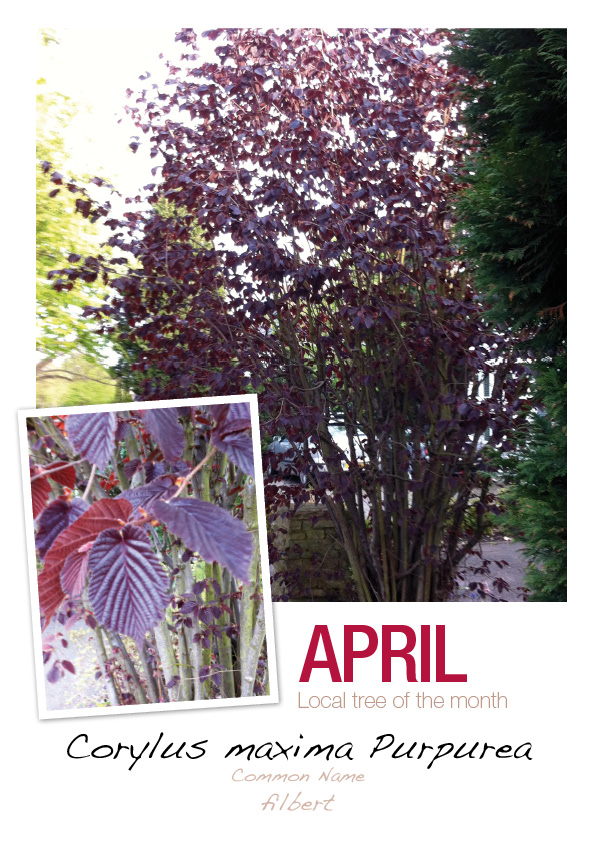
Corylus maxima Purpurea  (Common name Filbert)

I've been waiting for a couple of weeks to take some shots of this multi stemmed hazel on a sunny day. But it never happened - so my tree of the month for April, scrapes into May!
Standing in the front garden of a house on Coombe Lane, just opposite the junction of Cambridge Road. This purple hazel is especially eye catching at this time of year, when the foliage has newly emerged. The colour is just slightly more rich and intense. The typical multi stemmed tree creates an elegant goblet shape which works perfectly in this position, at the side of the driveway.
The Purple Hazel, Corylus maxima Purpurea, is a variety of Filbert hazel. This ornamental tree is also produces large, nuts with a pretty, wine-purple tinge inside them. It is very hardy and suitable for any soil, although it is not quite as good in the shade. Purple Hazel is a good hedging plant, and can reach about 10 metres if it grows freely as a tree. The great thing about these trees, is they are happy being pruned to keep them in a size and shape which works with your space. The Purple Hazel has won an RHS Award of Garden Merit for being easy to grow and lovely to look at.


Tuesday, 17 April 2012

Sculpture in the Garden

Last October I made my first visit to the Hannah Peschar Sculpture Garden, which opens once again in May. I look forward to my next visit, to see what has changed.


Here is a taster of what to expect.


www.hannahpescharsculpture.com


Friday, 13 April 2012

Garden Burner

Light up the longer evenings with this atmospheric garden burner.

I saw it at the Landscape Show at Olympia, on the Luxius Outdoor Kitchen stand.


Beautiful Sculpture

I'm always asked for ways to make enclosed spaces look more attractive.


If a wall has enough light, my first thought is to cover it with plants. Either climbers or 'Green Walls'. But a low maintenance and striking choice, is to place a sculpture there.
This rusted metal fern sculpture is beautiful, and is at Wisley at the moment.


April at RHS Wisley


This is one of the best times of the year to visit Wisley. The unusually good weather has made everything even more impressive.


The Magnolias and Camelias are particularly good, as we didn't have the usual high winds to destroy the blooms.


Even the new leaf growth looked stunning.


Wednesday, 14 March 2012

Wimbledon tree of the month. March

Acacia dealbata (also known as the Silver Wattle or Mimosa)
Once again, I've chosen an evergreen. Found on Murray Road towards Ridgway, this native to New South Wales, Victoria and Tasmania is a fine example with a beautiful shape. The shoots are noticeably angular in section and bear true, bipinnate, blue green leaves. It is not hard to see why the foliage is often included in cut flower arrangements with it's attractively fern-like leaves. The highly fragrant, and velvety looking flowers, are borne in spring, with spherical clusters of conspicuous yellow stamens. Although they do seem to be earlier this year.
   Acacia dealbata is tolerant of several degrees of frost and it has been known to survive at -10ÂșC for short periods. So this tree benefits from it's Southerly aspect. However, young plants are susceptible to cold Winter winds.
   The cut Mimosa flowers are harvested and given to women on International Women's Day in Italy, Albania, Russia and Georgia. While in India, they use the essence of the flowers in perfumes.


Tuesday, 28 February 2012

Wimbledon tree of the month. February

Cedrus libani  (Also known as Cedar of Lebanon)
On any visit to the grounds of Cannizaro House, you can’t help but be impressed by this statuesque tree. As you follow the path from the common to the main lawn area, you are 
faced with this dramatic specimen, which stands sentry, at the border of tended garden and woodland walks. 
   As with most of the trees I choose in the Winter months, this is evergreen, provides a strong foil to the woodlands behind. Few trees, deciduous or evergreen, can compare with the beauty and elegance of a mature Cedar, and it was extensively planted as part of the enduring landscape of some of our grandest stately homes and estates.
   Interestingly this tree does not originate from Lebanon but in fact was found growing on the slopes of Mount Lebanon in Syria. It requires full sun in well-drained soil, but will tolerate exposure.
   The Cedar of Lebanon has been important to various ancient civilizations. The trees were used by the Phoenicians for building ships, houses, palaces, and temples. The ancient Egyptians used its resin in mummification, and its sawdust has been found in the tombs of Egyptian Pharaohs. The Sumerian Epic of Gilgamesh designates the cedar groves of Lebanon as the dwelling of the gods to which Gilgamesh, the hero, ventured. So it somehow seems fitting to find such a tree in the grounds of one of Wimbledon’s most 
prestigious houses.